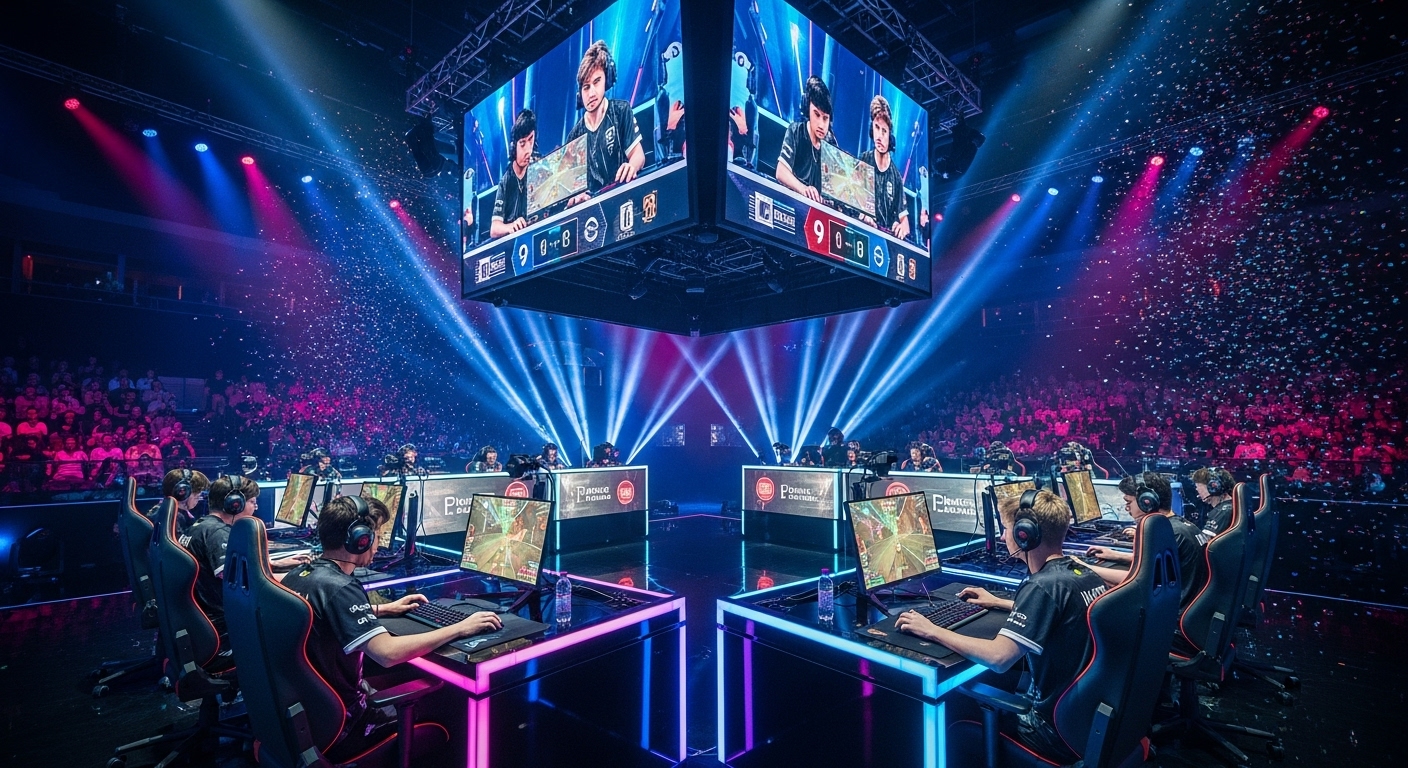

In the last few decades, the world of esports has transformed from a niche hobby into a global phenomenon. Once confined to basement tournaments and local arcades, competitive gaming has skyrocketed in popularity, attracting millions of viewers, professional players, and corporate sponsorships. Today, esports is not just a pastime; it is a multi-billion-dollar industry, with its own ecosystem of players, coaches, analysts, broadcasters, and fans. As gaming continues to evolve, esports is rapidly becoming a cultural and economic force, challenging traditional sports in ways never seen before.
In this blog post, we will explore the world of esports, its evolution, the factors contributing to its success, the players and organizations that make it tick, and where the industry is heading in the future.
The Birth of Esports: From Casual to Competitive
Early Beginnings
The roots of competitive gaming can be traced back to the early days of arcade games in the 1970s and 1980s. The first major tournament event for competitive video games was the Space Invaders Championship held in 1980 by Atari, which saw over 10,000 participants. This event, though small by today’s standards, marked the beginning of the concept of competitive gaming.
However, esports as we know it today did not truly begin until the late 1990s and early 2000s, when the internet began to enable global connectivity. In the early days of online multiplayer games, players were already engaging in informal competitions, primarily through LAN (Local Area Network) parties where gamers would gather together in one location and compete against one another. These were the humble beginnings of the esports scene.
The Rise of StarCraft and Early Competitions
One of the first games to pave the way for competitive gaming on an international scale was StarCraft, the real-time strategy (RTS) game developed by Blizzard Entertainment. Released in 1998, StarCraft captured the attention of gamers worldwide, particularly in South Korea, where it gained enormous popularity. South Korea’s competitive gaming scene flourished around StarCraft, culminating in televised tournaments and sponsorships. By 2000, StarCraft became the center of a competitive scene in Korea, and professional esports organizations were established to manage players, teams, and events.
This period also saw the creation of tournaments like the World Cyber Games (WCG) and Electronic Sports World Cup (ESWC), both of which became major events that brought together top players from all over the world. These tournaments helped to establish esports as a legitimate and organized competitive activity.
The Golden Age of Esports: Expanding the Audience
The Rise of Multiplayer Online Battle Arenas (MOBAs)
As internet connectivity improved, more complex and team-based games began to dominate the esports scene. One such genre that rapidly gained traction in the early 2010s was the Multiplayer Online Battle Arena (MOBA). The launch of League of Legends in 2009 by Riot Games marked a significant turning point in the popularity of esports. League of Legends became one of the most-played games in the world, thanks to its free-to-play model and its ability to bring together players in intense, team-based matches.
In 2011, the first League of Legends World Championship took place, and the tournament was an immediate success. This event is often credited with being the catalyst that propelled esports into the mainstream. The game’s competitive scene grew exponentially, and in 2013, League of Legends became the first esports title to attract a viewership of over 32 million people during its World Championship.
Around the same time, Dota 2, another popular MOBA developed by Valve Corporation, was also gaining momentum. Valve’s decision to host The International—an annual Dota 2 tournament with a multi-million dollar prize pool—further solidified the esports industry as a professional enterprise with high stakes. By 2014, The International offered a prize pool of over $10 million, and it was clear that esports was no longer a hobby but a legitimate industry.
The Emergence of Sponsorships and Corporate Involvement
With the growing popularity of esports, corporate sponsors and investors began to take notice. Brands such as Coca-Cola, Intel, Red Bull, and Samsung entered the scene, seeking to capitalize on the massive and passionate fan base of esports. The sponsorships helped improve the production quality of tournaments, leading to more elaborate live streams, better production values, and larger prize pools. At the same time, the increased visibility attracted a wider audience, including non-gamers who were curious about the competitive gaming world.
Esports also began to find a place on traditional media platforms. Networks like ESPN and TNT started broadcasting major esports events, making it easier for people to access and watch tournaments from the comfort of their homes. The transition of esports from being a niche activity to a legitimate form of entertainment was well underway.
The Structure of the Esports Industry
Professional Teams and Organizations
One of the key features of the esports ecosystem is the professional teams that compete in various games. These teams are often backed by large organizations and investors and are made up of highly skilled players who compete in tournaments, leagues, and cups throughout the year.
Some of the most well-known esports organizations include Cloud9, Team Liquid, FaZe Clan, G2 Esports, and Team SoloMid. These organizations not only manage player rosters but also serve as brands in their own right, with fanbases that rival traditional sports teams.
Professional players, once considered “just gamers,” now enjoy lucrative contracts and sponsorship deals with companies. These players dedicate their time to training, scrimming (practice matches), and competing in events. Many players also engage in content creation, streaming on platforms like Twitch and YouTube, further expanding their personal brands.
Esports Leagues and Tournaments
Esports tournaments can be broken down into several categories, including regional leagues, international competitions, and invitational events. In many ways, esports has adopted a structure similar to traditional sports leagues, with set seasons and championship events.
Some of the most prominent esports leagues include:
- League of Legends Championship Series (LCS): North America’s premier League of Legends competition.
- Call of Duty League (CDL): A league for competitive Call of Duty players, organized by Activision.
- Overwatch League (OWL): A league based on Blizzard’s Overwatch, featuring city-based teams around the world.
- Esports Championship Series (ECS): A major Counter-Strike: Global Offensive (CS:GO) league.
These leagues often operate in a way similar to traditional sports leagues, with teams playing throughout the season to qualify for playoffs or world championships. Tournaments like The International, League of Legends Worlds, and CS:GO’s ESL Pro League are the equivalent of championship finals, drawing millions of viewers and offering multi-million-dollar prize pools.
Streaming and Viewership
Another key component of esports’ meteoric rise is its integration with streaming platforms like Twitch, YouTube Gaming, and Facebook Gaming. The ability to broadcast live gaming content has turned esports into an accessible and highly engaging form of entertainment. In fact, esports viewership has reached staggering numbers—League of Legends’s World Championship in 2019 attracted over 100 million viewers, surpassing many traditional sports events.
Twitch, which was acquired by Amazon in 2014, has become the dominant platform for live streaming esports events, along with individual gaming streams. Top-tier esports events often have dedicated channels and hosts, providing coverage, analysis, and post-match interviews. As a result, fans can engage with their favorite games and teams in real-time, making esports a more interactive experience than traditional sports.
The Role of Coaches and Analysts
Esports has also seen the rise of professional coaches, analysts, and commentators, all of whom contribute to the overall spectacle. Just as in traditional sports, esports teams employ coaches who help players improve their strategies, teamwork, and mental game. Coaches have become a crucial part of the esports ecosystem, assisting players with everything from analyzing opponents to improving in-game performance.
Analysts and casters (commentators) play an equally important role in engaging the audience. These individuals provide live commentary during matches, breaking down complex gameplay and adding excitement to the event. Their role is not only to entertain but also to educate the audience, making it easier for newcomers to understand the intricacies of the game.
The Future of Esports
The Growth of Mobile Gaming
While PC and console esports remain dominant, mobile gaming is rapidly growing and could reshape the future of competitive gaming. Games like PUBG Mobile, Free Fire, and Clash Royale have found success in regions such as Southeast Asia, India, and Latin America, where mobile phones are often the primary gaming device.
In 2020, mobile esports saw significant growth, with mobile games attracting sponsorship deals, professional players, and tournaments. As mobile gaming continues to grow in both popularity and technology, we could see more emphasis placed on mobile esports in the coming years, particularly in regions where mobile devices are the primary gaming platform.
The Integration of Virtual Reality (VR) and Augmented Reality (AR)
Another exciting possibility for the future of esports is the integration of Virtual Reality (VR) and Augmented Reality (AR) into competitive gaming. While VR gaming is still in its early stages, it has the potential to revolutionize the esports scene by providing immersive experiences that could take competitive gaming to a whole new level.
Imagine competing in a Counter-Strike match where players are physically immersed in the environment, or participating in a Fortnite battle where you can see the action unfolding around you in real-time. VR and AR could create entirely new forms of esports that are more engaging, immersive, and interactive.
Increasing Legitimacy and Global Recognition
Esports has already made significant strides in becoming a mainstream sport, but it’s likely that in the future, we will see even more recognition. Many countries are starting to consider esports as a legitimate sport, with some even offering scholarships and funding for professional players. Esports may eventually be included in multi-sport events such as the Olympics or other international competitions, adding to its credibility and prestige.
The increasing investment in esports infrastructure, the rise of esports universities, and the expansion of esports viewership all suggest that the industry will continue to grow at a rapid pace.
Conclusion: Esports as a Cultural and Economic Powerhouse
The rise of esports has been nothing short of remarkable. What started as a hobby for a select group of gamers has evolved into a global phenomenon with millions of fans, professional players, and organizations involved. From its humble beginnings to its current status as a multi-billion-dollar industry, esports has changed the way we view gaming, entertainment, and competition.
As esports continues to expand, it is likely that we will see further innovations, new game genres, and a larger global presence. For players, fans, and investors alike, esports represents an exciting and evolving industry that shows no signs of slowing down. Whether you’re a casual viewer or a professional gamer, the future of esports promises to be as exciting and dynamic as the games themselves.